Guest
Con Raso
Con Raso is Founder and CEO at Tuned Global, as introduced on the show.
Episodes (2)
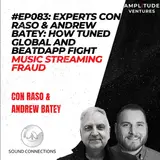
Con Raso of Tuned Global and Andrew Batey, founder of Beatdapp, explain how machine learning catches music streaming fraud and why it pays real artists more.
Con Raso, founder and CEO of Tuned Global, explains building a music licensing platform with 130 million tracks and expanding into Southeast Asia.
Questions these episodes answer
What kind of fraud does Beatdapp detect in music streaming?
Beatdapp sits underneath streaming services and analyzes thousands of data points per stream, including battery level, gyroscope orientation and what a user does before and after playing a track, across more than 600 machine learning models. About 80 percent of what it catches is financially motivated fraud run by organized crime, money launderers and even terrorist organizations, rather than real artists trying to game the charts.
From: How Tuned Global and BeatDapp Are Unmasking Fraud In Music
Does removing streaming fraud reduce how much money real artists earn?
No, Batey says the opposite happens: removing fraud reallocates the same pool of royalty money rather than shrinking it. He describes one artist whose streams were 47 percent fake in its first month, and even that artist earned 9 percent more once all the fraud across the whole platform was cleaned up, well beyond their own.
From: How Tuned Global and BeatDapp Are Unmasking Fraud In Music
How much money could be flowing through streaming platforms as fraud?
Batey estimates that roughly a billion dollars a year could be laundered through streaming services without detection, aided by the fact that fraud is spread across many distributors and platforms so no single point of failure shuts it down. He notes that just last month over 50 DIY distributors had more than half of all their streams flagged as fraudulent.
From: How Tuned Global and BeatDapp Are Unmasking Fraud In Music
What happens to distributors who built revenue on fraudulent streams once fraud detection becomes standard?
Batey says a distributor that grew its numbers partly through fraud can face clawbacks, since the fraudulent payouts get treated as advances the distributor now owes back, and its valuation can collapse once a buyer audits the real, non-fraudulent stream count behind its revenue.
From: How Tuned Global and BeatDapp Are Unmasking Fraud In Music
Should music startups raise money from venture capital firms?
Batey advises against chasing traditional VC money for a music startup, since roughly three quarters of music companies get acquired for under 15 million dollars, which does not fit the 50x to 100x return most venture funds need. He recommends raising instead from angel investors who genuinely care about the problem the company is solving.
From: How Tuned Global and BeatDapp Are Unmasking Fraud In Music
What does Tuned Global actually do?
Tuned Global is a technology platform that gives clients access to more than 130 million music tracks, the rights to use them, and context on how to use them, whether that means streaming, gaming, background music or in-flight entertainment. Raso says roughly 90% of the business relates to music, alongside services in live video and podcasting.
How did Con Raso get music labels to work with Tuned Global early on?
Raso says major labels were conservative and slow to trust an outsider, so he made a conscious effort to keep traveling from Melbourne to Sydney to build relationships and credibility with them over time, doing small projects together before asking for anything bigger. It took repeated in-person effort rather than a single pitch to earn that trust.
How did Con Raso raise the first outside funding for Tuned Global?
Raso says the team did well over a hundred investor presentations before finding a VC firm willing to provide seed capital, essentially camping on that firm's doorstep until it committed. The resulting business reached profitability quickly, though the investor later had to push Raso to spend that money faster instead of staying overly cautious.
What mistake does Con Raso say most music startup founders make when pitching investors?
Raso says most founders cannot clearly explain who their customers are or why those customers will actually pay, and cannot show real tests proving that demand instead of relying on wishful thinking. He argues investors reward founders who back up their idea with evidence, such as tests that show customers will pay, rather than a sky-high valuation based on gut feel.
How does Con Raso think AI will change the way people consume music?
Raso expects people to move away from downloading or subscribing to individual apps, toward an AI layer that sits between the listener and many different sources of music at once, assembling what fits what they want to hear. He compares it to how early web aggregators handled news, but says most current AI discourse focuses on training models rather than this shift in consumption.