Guest
Morgan Hayduk
Morgan Hayduk is Co-founder and Co-CEO at Beatdapp, as introduced on the show.
Episodes (2)
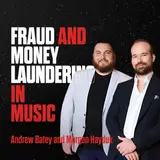
Beatdapp co-founders Andrew Batey and Morgan Hayduk explain how streaming royalty fraud and money laundering work, and how AI music changed the game.
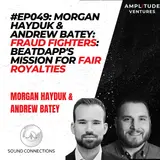
Morgan Hayduk and Andrew Batey, co-founders of Beatdapp, explain how they built streaming fraud detection and raised a $17 million Series A.
Questions these episodes answer
How does fraud actually work on music streaming platforms?
Batey explains that streaming royalties are paid from a shared pool rather than a fixed rate per stream, so every play a fraudster fakes takes a slice of money that would otherwise go to a real artist. Because the pool is finite and everyone competes for a share of it, running up fake streams directly extracts money from other people.
From: Industrial-Scale Money Laundering in the Music Industry
How does AI make music streaming fraud easier?
Batey says fraudsters used to need hacked user upload platforms or obscure old recordings from Africa, Latin America or Asia just to have enough content to run their schemes. AI removed that barrier, since generating large volumes of new filler tracks became simple, feeding fraud operations that need constant new songs to hide behind.
From: Industrial-Scale Money Laundering in the Music Industry
How is the music industry used for money laundering?
Batey describes organized crime converting cash into cryptocurrency, paying streaming farm operators to run fake plays on specific songs, and then collecting the resulting royalty payouts through shell companies set up in places like Doha, Canada, Hong Kong or Cyprus. Because the industry is largely unprotected, a few hundred million dollars can move this way without anyone noticing.
From: Industrial-Scale Money Laundering in the Music Industry
Why did Beatdapp refuse investment from music labels and streaming services?
Batey and Hayduk say they turned down money from any distributor, streaming service, label or other strategic investor from the very beginning, even though those insiders are usually the easiest source of early funding for a music startup. They wanted Beatdapp to be seen as a neutral referee on fraud, with no perception that any single industry player had influence over its findings.
From: Industrial-Scale Money Laundering in the Music Industry
Can AI models be traced back to the copyrighted songs they trained on?
Hayduk says attribution is still unresolved: nobody can currently prove with precision which underlying copyrighted works in an AI model's training data produced a specific piece of generated output. He treats claims of solved attribution with skepticism and says the technical problem has not actually been cracked yet.
From: Industrial-Scale Money Laundering in the Music Industry
What problem does Beatdapp solve in music streaming?
Beatdapp finds fraud inside the large data sets that determine how streaming royalties get split among rights holders. It began as an audit tool for royalty statement discrepancies and discovered those discrepancies were actually caused by fraud rather than bad DSP accounting, positioning it as a neutral third party that helps both rights holders and platforms fight the same problem.
How much of the fraud Beatdapp catches is financially motivated?
Andrew says about 80 percent of the fraud Beatdapp catches is financially motivated, meaning people quietly siphoning off royalty payouts, rather than attempts by artists or promoters to build a fake fan base or chart position.
How did Beatdapp get the data it needed to detect streaming fraud?
There is no public dataset for streaming fraud, so Beatdapp needed a DSP partner willing to share granular historical streaming data to build its first models. That first dataset showed a fraud rate north of 10 percent, which let Beatdapp estimate that a similar problem likely existed across other platforms too.
Why was Beatdapp's first fundraising round so difficult?
Andrew says it was the hardest round he has ever raised because most investors did not understand the music industry and had to be walked through how royalties and payouts work before they would consider funding a streaming fraud detection company.
Who invested in Beatdapp's $17 million Series A?
One notable backer was an investor named Jamie, who built the fraud detection company Verafin for the finance industry and, as Andrew recalls it, sold it for just under 4 billion Canadian dollars. His experience mapped closely onto how he expected Beatdapp's business and technology to work.